

Charitable vs Non-Charitable Foundations in the UAE
A charitable foundation in the UAE serves public benefit, while a non charitable foundation supports private wealth and succession planning, and understanding the differences helps families choose the right structure for their goals.
• The UAE recognises both charitable and non-charitable foundations across DIFC, ADGM, and RAK ICC.
• Charitable foundations serve public benefit, while non-charitable foundations support private wealth, succession, and family governance.
• Only charitable foundations can receive public donations.
• Non-charitable foundations can apply for tax transparency under UAE Corporate Tax Law if they meet Article 17 conditions.
• Choosing the right jurisdiction depends on purpose, governance needs, regulatory comfort, and asset mix.







Table of Content
- Charitable vs Non-Charitable Foundations
- What Is a Non-Charitable Foundation
- What Is a Charitable Foundation
- Key Differences Between Charitable and Non-Charitable Foundations
- Where can you set up your Charitable and Non-Charitable Foundation in UAE
- Examples of Charitable and Non-Charitable Uses in the UAE
- Frequently Asked Questions
- How Juriszone Can Help You
Charitable vs Non-Charitable Foundations
| Category | Charitable Foundation | Non-Charitable Foundation |
| Purpose | Supports public benefit activities (education, health, culture, environment, humanitarian work) | Supports private interests (family wealth planning, asset protection, succession) |
| Primary Objective | Promote social welfare and community development | Manage, protect, and distribute private family or business assets |
| Beneficiaries | Public or groups within charitable purpose | Private individuals selected by founder |
| Use of Funds | Only for charitable activities | Private purposes, investments, distributions |
| Donations | Can receive donations and grants | Usually funded by founder/family |
| Governance Requirements | Stricter reporting, audits, and regulatory approvals | Lighter oversight, private governance |
| Founder Control | Limited control; no private benefit | Founder may retain reserved powers |
| Legacy Focus | Long-term public benefit legacy | Long-term private family legacy |
| Regulatory Position (DIFC) | Recognised; strict public benefit requirements | Common for wealth and succession planning |
| Regulatory Position (ADGM) | Recognised; reporting conditions | Flexible control; strong asset protection |
| Regulatory Position (RAK ICC) | Less common | Main structure for asset protection |
| Common Uses | Scholarships, community projects, humanitarian programs | Real estate, family business shares, investments |
| International Operation | Yes | Yes |
| Documents Required | Charter, bylaws, due diligence, purpose docs | Charter, bylaws, due diligence, asset/beneficiary info |
| Distribution of Assets | No private distributions allowed | Allowed to private beneficiaries |
What Is a Non-Charitable Foundation
A non charitable foundation is a private wealth structure used for long term estate and succession planning. It allows families to centralise their real estate, company shares, investment portfolios, intellectual property, and financial assets in one legally recognised entity.
Key features:
• Assets can include real estate, company shares, IP, investments, and cash accounts.
• Founders can retain reserved powers and influence governance decisions.
• Beneficiaries are private individuals, usually family members or selected persons.
• The structure is ideal for asset protection, family business continuity, and inheritance planning.
Tax Treatment for Non-Charitable Foundations
Under Article 17 of the UAE Corporate Tax Law, a non-charitable foundation may apply to be treated as an unincorporated partnership. This means:
• The foundation is not taxed at the entity level.
• Income is allocated directly to the beneficiaries.
• Natural persons often have no corporate tax on passive investment income.
• The foundation must not conduct active business activities.
• All Article 17 conditions must be met, such as identifiable beneficiaries and proper substance.
This status supports families who hold passive assets such as real estate or investment portfolios and want predictable taxation across generations.
Families focused on safeguarding assets and planning long-term succession can also benefit from our comprehensive guide to wealth protection in Dubai, which explains strategic approaches used by HNWIs in the UAE.
What Is a Charitable Foundation
A charitable foundation in the UAE is a legally recognised structure created to serve public benefit purposes rather than private financial gain. This defining requirement means that all assets and income must be used exclusively for approved charitable activities.
Purpose and Scope
The foundation focuses on activities that contribute to social welfare, including education, healthcare, cultural development, environmental protection, humanitarian support, and community programs. These activities must directly align with the foundation’s public benefit mission.
Regulatory Oversight
Because the purpose is public benefit, charitable foundations operate under stricter regulatory controls. Authorities may require audited financial statements, regular reporting, and evidence that donated or invested funds are used correctly and transparently.
Founder Control and Governance
Founders have limited personal control over the assets once they are placed in the foundation. All decision making must support the charitable purpose and cannot provide private benefit to the founder or any individual.
Strategic Role in the UAE
Charitable foundations support the UAE’s long term goals for philanthropy, community development, and social impact. They allow donors and family offices to create an enduring legacy by contributing to regulated, mission driven initiatives that benefit society over time.
Key Differences Between Charitable and Non-Charitable Foundations

Although both structures are foundations, they serve different objectives and follow different regulations.
Charitable and non-charitable foundations in the UAE function under different legal purposes, with charitable foundations serving public benefit and non charitable foundations supporting private wealth and succession planning. DIFC, ADGM, and RAK ICC each provide specialised foundation frameworks that allow families and philanthropists to structure assets, protect wealth, or establish long term charitable impact. The key difference lies in how funds are used, who benefits, and the level of regulatory oversight required. Understanding these distinctions helps families choose the right jurisdiction, meet compliance expectations, and build a structure that aligns with their goals for governance, taxation, and legacy planning.
The key differences are outlined below.
Purpose and Objectives
A charitable foundation exists to serve a public benefit purpose. All activities must align with its charitable mission.
A non charitable foundation exists to serve private interests. These may include family succession, asset protection, wealth management, and holding of personal or business assets.
Beneficiaries
A charitable foundation benefits a community or a group of individuals who fall within the charitable purpose.
A non charitable foundation benefits private individuals chosen by the founder.
Source and Use of Funds
A charitable foundation may receive donations from the founder or the public, depending on licensing. Funds must only be used for charitable activities.
A non charitable foundation is funded by the founder or the family. It may use its assets for private purposes, including investment, asset management, and wealth distribution.
Governance and Oversight
Charitable foundations are subject to stricter oversight. They may require regular reports, audits, and regulatory approvals to ensure that their funds are used properly.
Non charitable foundations have lighter oversight obligations. Their internal operations remain private unless specific laws require disclosure.
Tax and Compliance Considerations in the UAE
Foundations in the UAE follow the rules of their respective jurisdictions. In most situations, charitable foundations may receive favourable treatment because they serve public benefit. Non charitable foundations must follow general compliance rules but are not required to follow charitable reporting standards.
Control and Flexibility
A charitable foundation does not allow the founder to use the assets for private benefit. The founder must allow the foundation to operate independently and in accordance with its charitable purpose.
A non charitable foundation gives the founder more flexibility. The founder can retain certain powers and can guide the long term management of assets.
Duration and Legacy
Both types of foundations can operate indefinitely. However, a charitable foundation creates a public legacy, while a non charitable foundation creates a private family legacy.
Where can you set up your Charitable and Non-Charitable Foundation in UAE
DIFC Foundations
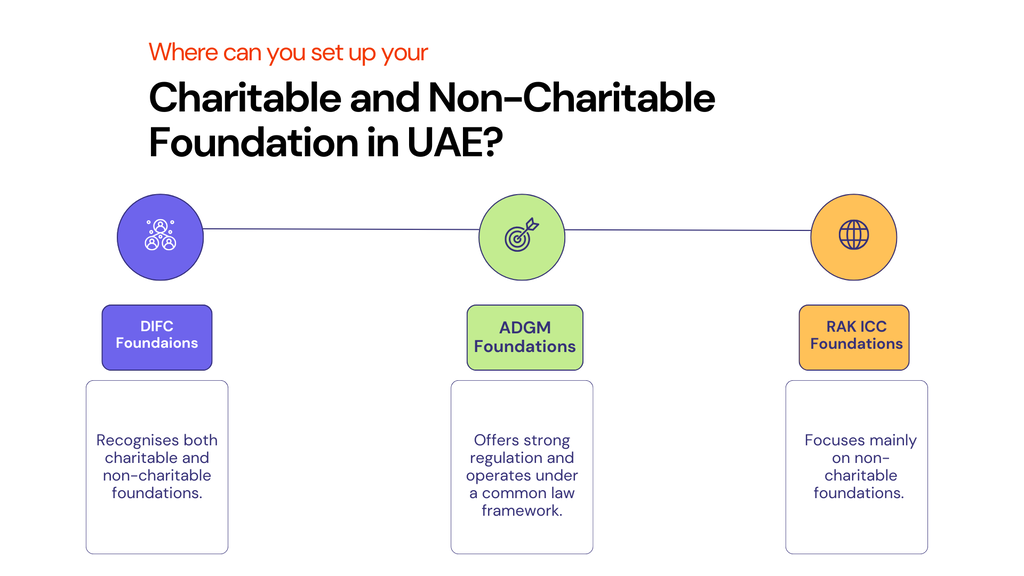
Dubai International Financial Centre recognises both charitable and non-charitable foundations. The DIFC Foundations Law sets clear rules for purpose, governance, and asset management. Charitable foundations must follow public benefit requirements, while non-charitable foundations are commonly used for private wealth planning through the DIFC foundation setup framework.
ADGM Foundations
Abu Dhabi Global Market offers strong regulation and operates under a common law framework. It recognises charitable and non-charitable foundations. Charitable foundations must meet public benefit and reporting requirements. Non-charitable foundations provide flexible control for families and long-term asset protection, making the ADGM foundation structure a popular choice for succession and wealth planning.
RAK ICC Foundations
Ras Al Khaimah International Corporate Centre focuses mainly on non-charitable foundations. These are used for asset protection, inheritance planning, and holding company shares. Charitable foundations are less common in this jurisdiction because its framework is designed primarily for private wealth structures, making the RAK ICC foundation setup ideal for families seeking a cost-effective asset-holding solution.
Steps to Create a Charitable Foundation in the UAE
Creating a charitable foundation in the UAE involves a structured approval process to ensure the organisation serves a genuine public benefit. The steps generally include:
- Define the charitable purpose
The founder selects the specific areas of public benefit such as education, healthcare, culture, or humanitarian support. - Prepare the charter and bylaws
These documents outline the mission, governance structure, roles of council members, and rules for managing funds. - Submit an application to the relevant authority
The application is filed with the regulatory body in the chosen jurisdiction. This may include DIFC, ADGM, or local government authorities for onshore charitable activity. - Provide due diligence documents
Authorities require identification documents, founder details, source of funds information, and compliance declarations. - Undergo regulatory review and approval
The authority reviews the purpose, governance model, and financial structure to confirm it meets charitable standards. - Register the foundation and receive a certificate
Once approved, the foundation is officially registered and can begin operating in accordance with its stated mission. - Maintain ongoing compliance
Charitable foundations must follow reporting rules, maintain proper financial records, and ensure all funds are used only for approved charitable purposes.
Get Free Consultation: Discuss Pricing Today!
Examples of Charitable and Non-Charitable Uses in the UAE
Examples of Charitable Foundations
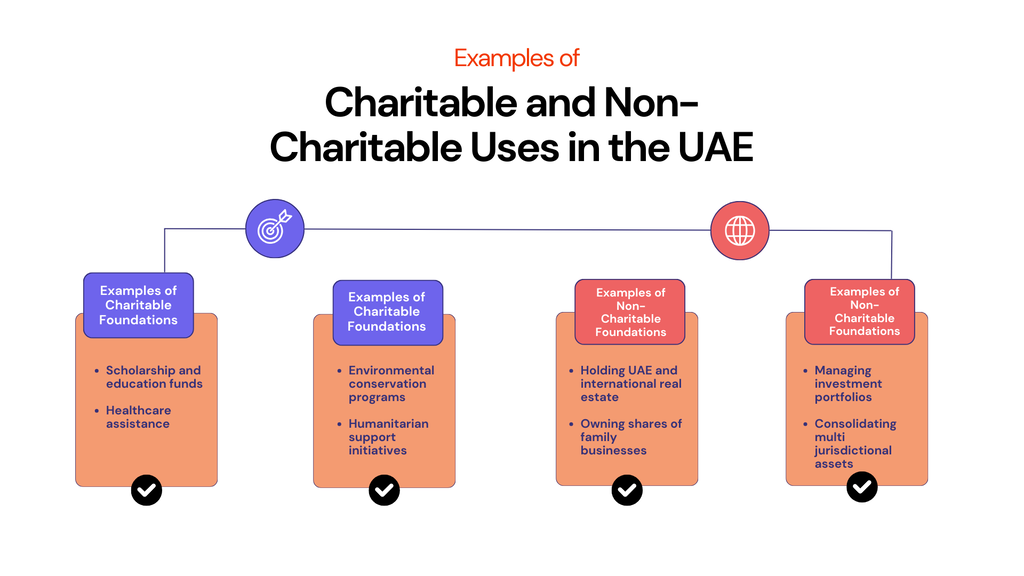
- Scholarship and education funds
- Healthcare assistance
- Cultural and community development projects
- Environmental conservation programs
- Humanitarian support initiatives
Examples of Non-Charitable Foundations
- Holding UAE and international real estate
- Owning shares of family businesses
- Managing investment portfolios
- Consolidating multi jurisdictional assets
- Creating long term family governance structures
Many of these use cases overlap with how a family foundation in the UAE is structured to hold assets, preserve wealth, and support long-term governance.
Frequently Asked Questions
1. Can a UAE foundation own property in Dubai?
Yes, depending on the rules of the specific emirate and free zone.
2. Can a non-charitable foundation donate to charity?
Yes, if allowed in its charter.
3. Can expats create foundations in the UAE?
Yes. Most founders in DIFC, ADGM, and RAK ICC are international families.
4. Is a foundation better than a trust in the UAE?
Foundations offer more control, perpetual existence, and are generally preferred for asset holding.
5. How does foundation registration differ from forming an NGO?
A foundation focuses on private wealth and asset protection, while an NGO is meant for non-profit charitable activities and public benefit.
6. What is property donation support in the UAE
It refers to assistance with legally transferring property as a gift to individuals, charities, or foundations.
How Juriszone Can Help You
Charitable and non-charitable foundations both play important roles in the UAE, and it is important that you choose the right structure.
This is where Juriszone adds real value. Our team helps founders look into each jurisdiction, select the right structure, prepare compliant documentation, and manage the full setup process with accuracy and confidentiality. Whether your goal is private wealth protection or long-term philanthropy, Juriszone provides end-to-end support to ensure your foundation is built on strong governance, clear purpose, and full regulatory compliance.
Families, individuals, or businesses looking for guidance in choosing the right structure can explore our UAE foundation setup services to ensure their charitable or non-charitable foundation is established correctly from the start.
Juriszone can guide you at every step and help you create a secure and future-ready structure.
Get Free Consultation: Discuss Pricing Today!
Written By
Senior Associate
Reading Duration:
10 Min Read

Private Foundations Setup in UAE: Guide (Tax Benefits, Setup, Costs)
Private foundations in the UAE provide tax-efficient wealth preservation for expat families. The UAE Corporate Tax Law introduced Family Foundation...

How to establish a Family Foundation in UAE?
A family foundation is a legal structure that manages family assets for current and future generations. It centralizes wealth management,...

Advanced wealth protection strategies UAE HNWIs [ Updated ]
Alan Wells Business Consultant